
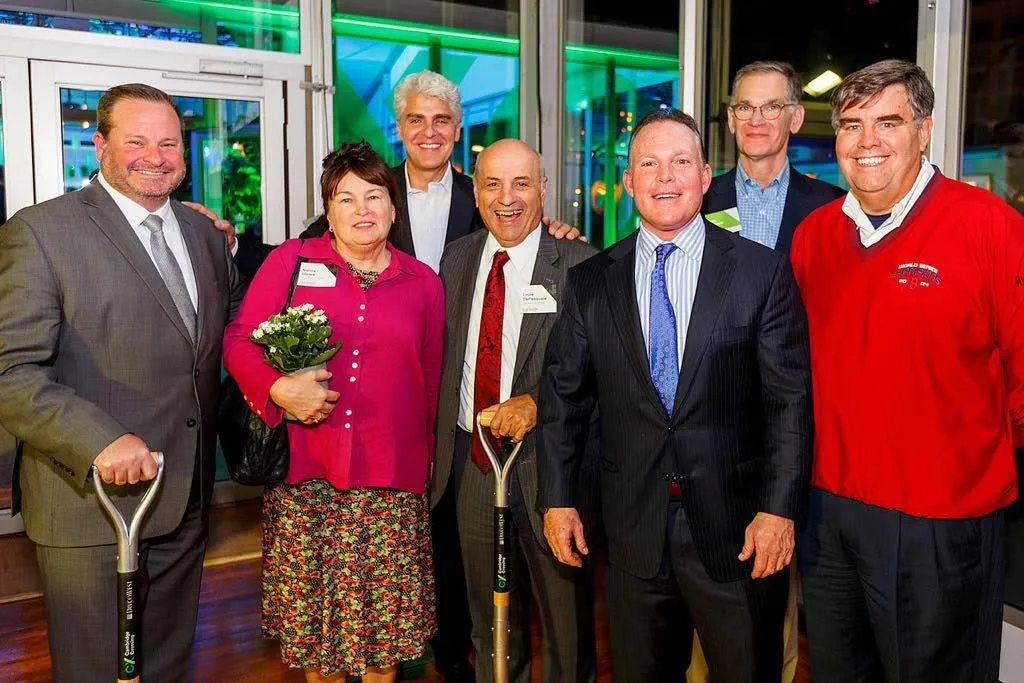
Anthony Galluccio
Written by: Travis Hutton
Published: March 10, 2026
Reading time: 13 minutes
Anthony D Galluccio is an attorney and law partner based in Cambridge. He is known as a land use attorney, a long public-service career, and years of coaching and charity leadership.
A winter rhythm of Relationship building
On many evenings in Cambridge, the city’s pace changes in familiar ways. Lights go on in municipal buildings. Doors close on committee rooms. Fields fill with the last practices of the day, even when the season says it should be too cold. There is a kind of local fluency in moving between civic systems and everyday lives. For Anthony it’s defined by relationships.
Anthony D Galluccio’s life has been built inside that rhythm. For years, it ran through City Hall , the Mayor’s office,school committee meetings and the council chamber. Later it ran through the State House. Now it runs through law offices and permitting meetings, and back out again to youth sports fields, participating in community affairs and non profit work and helping individual families. The throughline is not a slogan. It looks more like repetition: showing up, collaborating, making it personal ,finding a way to make progress, community driven movement, and doing it again.
He is based in Cambridge. He grew up there. His current professional role is attorney and law partner at Galluccio & Watson LLP, with a focus on municipal and land use permitting law. Alongside that, he coaches teams and has for many years. He also runs and supports charity work that has taken shape over decades. Today he runs from a public hearing on a development project to an educational panel or advisory board to a sports practice. Every day is different but the balance remains the same.
A boyhood shaped by public life and a sudden absence
Cambridge is the kind of place where local history sits close to daily life. For Galluccio, it began at home.
He grew up in Cambridge with a father who was a public figure. His father had served as campaign secretary for John F. Kennedy after meeting him at Harvard, and the two were described as close friends. After World War II and Harvard Law School, his father became a key campaign secretary. He also served in elected office.Anthony was raised in a world of values. Visiting the grandparents, work, running errands for neighbors, keeping your word and the politics shaped by Tip Oneil and local politicians that served as social workers not social media influencers.
Then came the disruption that became part of the long arc of the family’s story. His father died when Galluccio was 11. The loss presented difficulties for the family. Cancer was sudden and disastrous. Unprepared financially,Middle class life became a struggle. Emotional well being became looking for a life raft. Two parents with a comfortable life became a mom alone with three kids all on her shoulders.
In later years, parts of his personal story included other strains. He has described the long-term illness and death of his mother, family health issues, and personal mistakes as part of the material that shaped him. Maybe grief and trauma became demons and the root of mistakes but he makes no excuses. Anthony takes time to address young people regularly about the risks of not addressing and processing grief and trauma. He speaks openly about the risk of unhealthy escape behaviors. His acknowledgements of mistakes come without excuses.They read as a pattern of endurance and recalibration, self improvement and a tendency to pivot and focus on opportunity not setback. He is very proud of his evolution and personal conquests more than his professional heights.
School, work, sport, and the commitment to investing in relationships
Galluccio’s education stayed close to home at first. He attended Cambridge Rindge & Latin School, graduating in 1985. He was a three-sport varsity athlete and baseball captain. Anthony worked since the age of 12 . From paper routes to selling papers in Harvard square and working for a local tailor after school he thrived with people. Losing his Father and going from middle class to far less than created a survival skill. He became focused on building a network of friends and a support team far outside his family. He shoveled the neighbors , delivered papers and had 15 different jobs throughout high school. Sports and work was about relationships building. His bosses became mentors and lifelong friends.A network that became the beginning of his political base.
He went on to Providence College, graduating in 1989. Again working almost 20 different jobs during school at night and in summers. He majored in Political Science and minored in Business. From unloading trucks, life guarding,cleaning gym floors to working as a doorman and delivery and every job in between Anthony embraced work. More than the money, each job meant new friends and a bigger network. On campus and off he created a network that became his canvas.Each work place , each class or study group every new gym he found to work out meant a new organism with a complex human element. Each presented a unique culture to embrace and assimilate in.
He completed Suffolk Law School in 1996, graduating cum laude.
Anthony began working as a filing clerk then corporate paralegal in downtown law firms. He studied obsessively to improve his test scores to get admitted to night school at Suffolk Law. Anthony worked full time as a legislative aid honing his political knowledge while attending law school at night. Each phase of work and school created more opportunities for new friendships and human interactions. In Galluccio’s case, the innate discipline to use work and school as opportunities not just for a pay check or education and work experience but for sincere relationships, all while staying rooted in Cambridge.
The long apprenticeship of local government
Some political careers are short and sharp. Others are long and municipal, built in meeting rooms and service calls and the mundane conflicts that define a city’s daily life. Galluccio’s belongs to the second category.
Recruited to become class president in elementary school and student Government in high school were early signs of interest. He interned at the state house and served as a legislative aid while in law school. He served on the Cambridge City Council from 1994 to 2007. During that period, he served as Mayor of Cambridge from 2000 to 2001. The years matter because they suggest a full apprenticeship in local politics: the slow accumulation of knowledge about how a city actually runs, what residents ask for, what departments can and cannot do, and how decisions are made under pressure.
In 2007 he moved to a broader stage, serving as a state senator from 2007 to 2010. His senate role covered a district including Cambridge and surrounding communities. During his tenure he chaired the Massachusetts Senate Higher Education Committee. That post placed him at the intersection of public investment, institutional ambition, and the practical concerns of students and families. Higher education policy is often discussed as an abstract good. In practice it is also a set of tradeoffs: budgets, access, governance, and the relationship between universities and the cities around them.
His political timeline is not an add-on to his legal work. It explains part of his professional posture. A network of friends from every facet and stage of life was his foundation. Relationships and years around the government helps to understand how decisions feel from the inside with an expertise in empathy and relationship building as a survival skill not a hobby.
Law as the next platform
After public office, Galluccio built his legal career around the kind of work that sits at the seam between public rules and private ambition.
He opened Galluccio & Watson LLP in 2010 with Cheryl Watson Fisher. He has been a law partner for 15 years. Cheryl was an experienced City Solicitor and Anthony decades in elected office. Both Neighborhood kids wanted to serve the community. Expertise and a will to help the community. In time Anthony became a proven land use attorney on large complex projects. It is where ideals meet zoning codes, where plans meet neighbours, and where a project can live or die in process.
He represents major institutional and real-estate clients, including large developers and landowners. He has undertaken new zoning petitions that have shaped the city and created housing and economic and fiscal stability. He is described as widely regarded as a top land use permitting attorney in Cambridge ,Somerville and Greater Boston.
The work is not a courtroom drama. It is the community trust,patient craft of approvals, compliance, persuasion, and negotiation. In many cases the central question is not whether something should exist, but whether it can be made to exist in a way that fits the rules, addresses concerns, and moves through public channels without breaking trust.
He has described the measure of success in his career as clients being approved but the community winning. The language is blunt, but in permitting work, outcomes are concrete. Approval is the difference between a plan on paper and a project in motion. Good projects mean both the client and the community wins.
Coaching as a second civic role
If law is his professional platform, coaching appears to be his second civic role, one he has held for decades.
He has coached youth baseball and football since 2003. He served as head coach of Cambridge Pop Warner football from 2009 to 2015. During that period, he founded Cambridge’s first unlimited-weight Pop Warner team, recruited door to door, and helped lead it to the playoffs.
He volunteered as an assistant football coach at Cambridge Rindge & Latin School from around 2003 to 2013, including strength and conditioning and position coaching. In baseball, he coached Little League and travel and All-Stars every summer from 2009 to 2019, and he assisted with CRLS baseball at the freshman and JV level and helped with varsity from 2015 to 2017.
In the Lou Tompkins travel baseball league, his teams reached significant postseason results, including a 15U title in 2023 and semifinal appearances in 2022 and 2024.
He organised multiple, free, pro baseball clinics led by pro players, serving more than 300 kids. He has coached more than 450 baseball games as a head coach.
That body of work suggests something more than a hobby. Coaching at that scale becomes a kind of parallel institution. It creates continuity for kids and families, particularly in cities where opportunities can depend on who knows how to access them. It also creates a public presence that is different from politics. Coaching is not campaigning. It is being there on weeknights and weekends, dealing with losses and small conflicts, building habits, and keeping your promises.
Galluccio lists fitness and coaching as interests. His interviews point repeatedly to adversity, pivoting, and daily discipline. He served as strength coach for CRLS high school football and volunteered at the Special needs weightlifting program in Cambridge. There is a way those themes line up with sport: every day is like a game, the need to win the day, the habit of improving.Countless friendships were built in gyms and weightrooms.
A long-running charity infrastructure
Galluccio’s charity work is extensive and structured. It includes a 501(c)(3), direct aid programs, and longstanding partnerships.
He has been president of Galluccio Associates, a 501(c)(3), since 1994. The organization has donated more than $300,000 to youth sports and scholarships.
He founded Hope for the Holidays in 2007, now partnering with St Paul AME church and local non profits and supporting around 40 families per year, with around $250,000 in direct aid distributed.
He founded Ashley’s Angels in 2009, partnering with Dana-Farber Global health initiative and now the Voluntariados Con Jesus por ninos in the Dominican Republic and donating more than $300,000 to pediatric oncology at Arturo Grullón Children’s Hospital in Santiago.
He served on both the Hildebrand Family Self Help Center and Centro Latino boards for a combined two decades fighting for families in transition and immigrants.
His philanthropic focus includes saving kids with cancer, helping low-income kids play sports, and supporting the needy. He also notes that he eliminates escape behaviours like alcohol, and links that choice to balance across charity, fitness, volunteering, and family support to others. In his own life story, alcohol is listed under what to stay away from.
These efforts are not one-off events. They resemble an infrastructure that runs year after year: recurring programs, repeated deliveries, sustained fundraising, and the kind of logistical persistence that is often invisible from the outside.
The work also carries a geographic reach. He is fluent in Spanish and is described as deeply involved in Boston’s Latino community. His efforts include annual scholarships for Dominican-American students and regular shipments of baseball equipment to leagues in the Dominican Republic.
Recognition and the public face of service
Public service often comes with awards, but the meaning is usually less about ceremony and more about the networks it reflects.
Galluccio received the Cambridge NAACP Public Service Award in 2002 and the JFK Library Fenn Award in 2001. He has also received multiple immigrant and Latino community awards and legislative recognitions through 2010 and beyond.
He was honoured as Man of the Year for a Dominican Independence Celebration in 2010. In 2023, he received recognition as Grand Marshal and an international friend designation. He received charity awards in 2024.
Those markers situate him as a figure who has operated across communities: local civic institutions, higher education policy, legal systems, youth sports networks, and immigrant community organisations. The recognitions are diverse, and that diversity points to a broader pattern: a life that stays public, but in different registers.
The discipline of reinvention
There is a temptation to treat careers like straight lines: school, politics, law, charity. Galluccio’s looks more like overlapping lanes.
He has described overcoming adversity and pivoting as a central part of his interviews. He has also framed setbacks as fuel for recommitment to core values and for emotional self-awareness. He speaks in the language of repetition and daily effort rather than grand transformation: every day is like a game, remembering he overcame the last challenge, improving every day.
That posture fits the kind of work he does now. Permitting law rewards patience and process. Coaching rewards consistency and presence. Charity work rewards logistics and the ability to keep the machine running. All of it depends on the unglamorous skill of returning to the work even when there is no applause.
In his professional focus, the problems are often structural and procedural: municipal rules, land use constraints, permitting pathways. In his volunteer work, the problems are often human and immediate: families needing support, children needing equipment, young athletes needing a place to belong, hospital wards needing resources.
The combination suggests a particular kind of local power, one that is built less on visibility and more on function. The person who knows how things work can make things happen. The person who keeps showing up can make the help real.
Anthony D Galluccio in Cambridge now
In Cambridge, the distance between civic life and personal life is often short. People run into one another at schools, at city meetings, at athletic fields. Institutions are close enough that a person can inhabit several of them at once. Recently he was a panelist on a high profile equity report conducted by the Cambridge Community Foundation. He was appointed to the advisory committee on the renovation to Cambridge’s largest recreational space. He volunteers at the MIT job Connector helping residents access the building trades.
Anthony D Galluccio occupies that kind of proximity. His career includes years on the Cambridge City Council, a term as Mayor, and service as a state senator who chaired the Senate Higher Education Committee. His current work as an attorney and law partner centres on municipal and land use permitting, representing major institutional and real-estate clients. Alongside it, he coaches youth sports at a scale that reads as a second vocation. He also runs and supports charity programs with concrete metrics, sustained over decades.
It is a combination that fits the moment Cambridge and similar cities are living through. Land use and permitting shape housing, institutions, and growth. Youth sports and school communities shape belonging. Philanthropy and direct aid fill the spaces where needs outpace systems.
In his case, the connection among those arenas is not abstract. It is practical. It lives in approvals and schedules, in clinics run for hundreds of kids, in funds directed to scholarships and medical care, in the steady choice to stay close to place and keep working within it.